
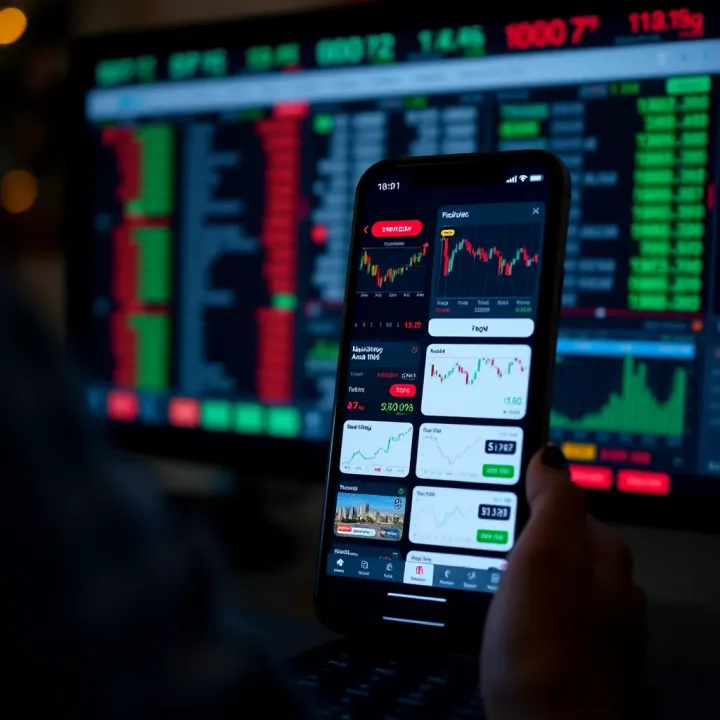
Choosing the Best Trading Apps for Indian Investors
Explore top trading apps for Indian investors 📱 Find how to choose the best platform with security, features, user experience and investment goals in mind.
Edited By
Henry Lawson
Demo share market apps provide a practical environment for Indian investors to sharpen their trading skills without risking actual money. These apps simulate real stock market conditions using virtual funds, so you can try out different strategies and get a feel for market behaviour.
Such apps are especially useful for beginners who want to understand how the Sensex or Nifty 50 react to various events before committing their savings. Even seasoned traders can benefit by testing new approaches during volatile times, without the fear of losing capital.

Using demo apps helps you develop confidence, understand order types, and practice execution, so that when you enter the live market, your decisions are more informed.
Most demo apps offer features like real-time price updates, historical data, and virtual portfolios that closely mirror Indian market conditions. You can place buy or sell orders, explore different sectors, and monitor performance as if you were trading on popular platforms like Zerodha, Upstox, or Angel Broking.
Key benefits include:
Risk-free practice: No chance of losing money while learning.
Familiarity with trading platforms: Navigate interfaces used by Indian brokers.
Strategy testing: Try intraday, swing, or delivery trades to identify what works best.
Market understanding: Observe how corporate announcements or RBI policy changes affect stocks.
However, it's essential to remember that emotions like fear and greed are often muted in demo trading. This sometimes leads to behaviour that differs from real trading, so while demo apps are invaluable for learning mechanics, they can't fully replicate live market psychology.
Choosing a good demo app means looking for ones with updated Indian stock data, intuitive design, and enough features to simulate real trades effectively. Some apps also offer tutorials and community discussions, making it easier to learn step-by-step.
In summary, demo share market apps offer Indian investors a safe space to build trading skills by practising with virtual money, examining market trends, and refining strategies before going live with their capital.
Demo share market apps provide a risk-free way for investors to practice trading without using real money. These platforms simulate actual market conditions, allowing users to learn how stock exchanges like the National Stock Exchange (NSE) and Bombay Stock Exchange (BSE) function in India. For new traders especially, demo apps help bridge the gap between theoretical knowledge and hands-on experience.
Demo apps create a virtual trading atmosphere where users can place trades as if they are in the real market. This simulation includes familiar elements such as buy and sell orders, price fluctuations, and market news, but no actual financial transactions happen. For instance, a trader could try buying shares of Reliance Industries Limited with virtual funds to see how the trade would likely perform.
Users get a fixed amount of virtual money, typically ₹10 lakh or so, to invest. The app uses real or slightly modified market data to shape price movements, making the experience close to actual trading. However, this means the risk is nonexistent; losses or gains only affect the virtual balance. This setup encourages experimentation with different strategies without the fear of losing hard-earned money.
The main goal is to help users understand market mechanics like order placement, price changes, and timing trades. Demo apps are vital for grasping how various factors, such as market volatility and liquidity, impact investments. For example, a beginner practising limit orders versus market orders will see their differences in execution and outcomes before transitioning to live markets.
Effective demo apps pull real or near-real data from Indian exchanges like NSE and BSE to ensure users face market conditions close to reality. This data includes stock prices, indices like Nifty 50 and Sensex, and relevant news. Simulating these helps traders understand the Indian market's unique behaviours, such as how monsoon seasons or quarterly results filings affect stocks.
Some demo platforms provide live market feeds, updating prices every second, while others use delayed data, lagging by several minutes. Real-time updates offer a more authentic and challenging trading experience, which can be crucial for day traders who depend on quick decisions. Delayed feeds might suit beginners focusing on learning basic concepts without the pressure of rapid changes.
Beyond shares, demo apps often include Indian financial instruments such as derivatives like futures and options, commodities, and ETFs (exchange-traded funds). This integration familiarises users with the range of trading opportunities available on Indian platforms. For example, practising a nifty futures trade within a demo app allows investors to understand leverage and risks specific to those contracts.
Using demo share market apps tailored for Indian markets can speed up your learning curve, helping you build essential skills in a safe environment before entering live trading.
This foundational understanding is crucial for anyone serious about investing or trading in India’s evolving stock market ecosystem.
Demo share market apps offer a practical space for Indian investors to get hands-on experience without risking real money. Understanding their key features helps in selecting the right app and making the most of its tools for trading practice.
Ease of use for beginners is vital since many users are new to stock trading. Apps with clean interfaces and straightforward menus remove the intimidation factor. For instance, a well-organised layout that separates watchlists, order placement, and portfolio views helps newcomers quickly find what they need without confusion.
Availability on mobile and desktop is another practical aspect. Many Indians access apps primarily on their mobiles, especially in tier-2 and tier-3 cities. Demo apps that function smoothly on both platforms offer flexibility – you might check your portfolio on the move and perform detailed analyses on a desktop at home.
Customisable dashboards let users arrange widgets like charts, watchlists, and news feeds to suit their style. This personalisation helps investors focus on what matters most – for example, a day trader might prioritise live charts and quick order forms, while a long-term investor could keep portfolio summaries front and centre.
Charting and technical indicators are essential for studying price patterns and market trends. Demo apps providing indicators like Moving Averages, RSI, and Bollinger Bands let investors practice analysis skills before applying them in real trades. This hands-on approach is useful for understanding how Indian market instruments like NSE stocks respond to such tools.

Order types and trade execution features mimic real market conditions. Availability of market, limit, stop-loss, and bracket orders lets users test different trade approaches. For example, using stop-loss orders in a demo app can show how it protects capital during sudden market dips, helping build disciplined risk management.
Portfolio tracking and reports provide users with a summary of their holdings, profit/loss, and investment allocation. Features that generate periodic reports enable investors to review strategies and spot areas for improvement. Such tracking mirrors actual brokerage platforms, preparing users for seamless transition.
Tutorials and guides within the app simplify complex concepts, like margin trading or option buying. These resources cater to self-learners who may not have access to formal courses, offering step-by-step instructions and examples tailored to the Indian market.
Market news and updates integrated in the app keep users informed about economic events, company earnings, or RBI policy changes. Timely insights enrich the demo trading experience by linking theory to current affairs, aiding investment decision-making.
Demo trading contests and challenges add a fun, competitive edge to learning. Participating in these events encourages users to try varied strategies within a risk-free setup, often with rewards or recognition. This feature motivates regular practice, sharpening skills steadily.
Exploring these key features thoroughly can accelerate your understanding of share market dynamics before you invest real money.
By focusing on such practical aspects, Indian investors can find demo share market apps that suit their experience level and trading goals effectively.
Demo share market apps provide Indian investors a safe space to get hands-on experience without risking real money. They help you understand how the market works, build confidence, and keep costs low while getting a feel for trading strategies and market behaviour. These benefits come especially handy for beginners from tier-2 or tier-3 cities where access to trading courses may be limited.
Understanding order placement is fundamental to trading. Demo apps let you practise buying and selling shares on the National Stock Exchange (NSE) or Bombay Stock Exchange (BSE) using virtual money. You get to try different order types—like market orders, limit orders, and stop-loss orders—without worrying about losing your money. This hands-on practice helps you grasp how orders get executed and the effect of timings or price changes.
Familiarity with market volatility is essential because the Indian stock market can swing sharply, especially around quarterly results or global events. Using a demo app, you get comfortable with price fluctuations and learn to react calmly. You can observe how sudden news affects shares of companies like Reliance Industries or Tata Motors, which builds an understanding of market rhythms without financial pressure.
Testing trading strategies safely means trying out different approaches—like intraday trading or holding shares long-term—before investing actual funds. For example, you could simulate buying shares during a market dip and selling when prices rise, assessing the strategy’s effectiveness. Demo apps offer the chance to refine strategies and correct mistakes without real losses.
Practising timing and decision-making improves with regular use of demo apps. You develop an instinct for when to enter or exit trades by following movements in stocks like Infosys or HDFC Bank. This practise is crucial because timing often impacts profitability more than choosing the perfect stock.
Simulating long-term and short-term trades helps you test both styles. You can hold virtual shares for weeks or months to understand compounding returns or try quick trades to benefit from intraday volatility. This flexibility suits different investor goals and enhances your ability to plan real investments.
Overcoming emotional barriers is often underestimated. Demo trading removes financial stress while helping you face common challenges like fear of losses or greed. With repeated practise, you build resilience against rushed decisions during market ups and downs.
Many traders fail not because of lack of skills but due to emotional reactions. Demo apps act as a training ground for mastering your psychological responses.
No brokerage or transaction fees make demo apps very affordable. In real trading, frequent calls or intraday trades can rack up significant brokerage costs, but demo trading is free. This cost-saving encourages experimenting without financial hesitation.
Accessible on multiple devices such as smartphones, tablets, and desktops, demo apps allow you to practise anytime, anywhere. For instance, you can keep an eye on your virtual portfolio during a commute on your mobile or analyse charts in detail on a computer at home.
Suitable for tier-2 and tier-3 city users where financial education centres might be scarce, demo share market apps bridge the gap. As long as you have a basic internet connection and a compatible device, you can explore the stock market from places like Jaipur, Coimbatore, or Guwahati, gaining exposure equal to metropolitan traders.
By taking advantage of these benefits, Indian investors can sharpen their trading skills effectively and ease into real money investing with greater confidence and understanding.
Demo share market apps are valuable learning tools, yet they come with limitations that Indian investors must keep in mind. Understanding these constraints helps set realistic expectations and ensures better preparation before moving to real trading.
Lack of real financial consequences means that losses in demo trading do not impact your actual capital. While this removes risk, it also removes the real stakes that often govern trading behaviour. Real money usually prompts more cautious and disciplined decisions, which demo trading might not encourage.
Potentially less emotional engagement occurs because demo trading uses virtual money. This setup might fail to replicate the stress or excitement experienced during live trades. Without emotional pressure, traders might take risks or hold positions longer than they would in real markets. For example, holding onto a losing stock in demo mode may feel less urgent compared to risking actual money.
Order execution variations also exist between demo and real markets. Demo platforms tend to fill orders instantly at displayed prices, but live market trading can include delays, slippage, or partial fills. These differences can affect strategy outcomes when you switch to real trading, especially for intraday or high-frequency trades.
Some demo apps deliver delayed market data instead of live quotes. This lag can range from a few minutes to longer, particularly if the app uses free data feeds. Outdated prices affect how accurately you can react to market moves and can mislead on order execution timings.
The impact on decision-making can be significant. If your demo app shows stale data, you may develop timing habits that don't work with live markets. For instance, placing trades based on outdated prices might cause frustration when real trades get executed at different levels.
Therefore, choosing apps with live or near-live feeds is critical for serious learners. Many Indian brokers now offer demo apps linked to real-time National Stock Exchange (NSE) and Bombay Stock Exchange (BSE) data, providing a closer feel to streaming market conditions. These apps enable you to test strategies with a better sense of timing and market dynamics.
Selecting a demo app with live feeds bridges the gap between practice and reality, reducing surprises during real trading.
A possible false sense of security may develop if you overtrust demo results. Profits made on paper might not translate into real gains because emotions, liquidity, and market impact are missing factors. Demo profits can make traders overconfident, leading to larger real losses.
Transition challenges to real trading often catch investors off guard. They might struggle with managing emotions, handling sudden losses, or dealing with brokerage charges absent in demos. Unlike virtual platforms, real markets require quick decision-making when prices move rapidly, and mistakes have financial consequences.
To mitigate this, the importance of gradual exposure cannot be overstated. Start with small live investments after demo practice, learning to handle volatility and emotional pressure. This gradual approach builds resilience and improves your readiness for full real market participation.
Understanding these practical limitations ensures you use demo share market apps wisely. Treat them as training grounds, not final testing, and combine learning with cautious real trading to build lasting skills.
Picking the right demo share market app is crucial for effective learning and strategy testing before investing real money. Not all apps are created equal—some offer features tailored to Indian markets, while others miss essential tools or may lack reliability. Knowing what to look for helps you avoid wasting time or getting frustrated, ensuring the practice you do translates well when you move to real trading.
User reviews and ratings provide an honest glimpse into the app’s performance and user satisfaction. Before downloading, check platforms like the Google Play Store or Apple App Store to see how fellow users rate features such as ease of navigation and accuracy of simulated market data. For example, an app like 'Upstox Pro Demo' often scores well due to its simple interface and real-time updates, whereas some less popular apps report frequent crashes.
App stability and speed matter a lot, especially if you plan to simulate intraday or swing trading where timing is key. An app that lags or frequently disconnects can distort your learning experience and create frustration. On smartphones with limited memory or older Android versions, app responsiveness becomes even more critical. Apps optimised for India-specific networks tend to perform better in tier-2 and tier-3 city locations.
Range of financial instruments covered is another important factor. A good demo app should offer simulated trading not just in stocks from NSE or BSE but also derivatives like futures and options, sometimes even commodities or currency pairs. This variety helps investors familiarise themselves with multiple markets. For instance, 'Zerodha Kite Demo' supports equity, commodity, and currency trading, making it more versatile for Indian traders exploring different avenues.
Support for NSE, BSE stocks and derivatives is essential because these are the primary Indian exchanges investors trade on. Demo apps that reflect the actual market conditions on NSE and BSE allow you to practice authentic trades, including indexes like Nifty 50 or Bank Nifty. Without this, the simulation could mislead or offer limited learning.
Inclusion of Indian financial news within the app can enrich your trading experience. Market sentiment hugely affects stock prices, so apps that feed the latest headlines and corporate announcements help you connect news with price movements. Such features aid in practicing fundamental analysis effectively within a demo setting.
Regulatory compliance and data security ensure the app respects investor privacy and handles data securely, especially if it asks for personal information, even for demo accounts. Apps compliant with SEBI guidelines and using encryption reduce the risk of data leaks. Always check the app's privacy policy and review whether it follows recognised Indian cyber laws.
Many demo apps offer free versus paid plans. Free plans usually provide basic features sufficient for beginners, but paid versions might give better data feeds, more trading instruments, or additional educational content. For example, '5Paisa Demo' offers a free basic version but charges for advanced charting tools. Consider how much you want to invest in learning before deciding.
Device compatibility is key since many investors rely on mobile trading. An app working smoothly on both Android and iOS, and also accessible via web browsers, offers flexibility. For users in areas with slow internet or older devices, light apps with offline functionality might suit better.
Customer support availability can make or break your experience. If you face technical issues or need guidance on how the app works, responsive support via chat, email, or phone is valuable. Apps backed by reputable brokers in India, like ICICI Direct or Angel Broking, often provide dependable support.
Choosing a demo share market app that fits your needs and Indian market realities will enhance your learning and prepare you better for real trading challenges.
Making a careful choice up front saves you effort and ensures your demo trading experience is as close to the actual market as possible, helping improve your confidence and skills effectively.
Using demo share market apps effectively means more than clicking through charts and placing trades. To truly benefit, you need clear goals, tested approaches, and a smooth move from practice to real trading. Let’s look at these practical tips that can help you make the most of demo trading.
Defining learning objectives gives your demo trading a clear purpose. Instead of randomly experimenting, decide what skills or knowledge you want to gain — for example, understanding limit orders, practising stop-loss placement, or learning how market volatility affects stock prices. Setting such goals helps you focus your efforts and review progress effectively.
Focusing on risk management in the demo environment trains you to control losses even when no real money is on the line. Use the demo platform to practise setting stop-loss and target prices to avoid big losses. This habit protects your capital once you begin trading with real funds.
Tracking progress continuously means regularly reviewing your trades to identify patterns in your decisions. Many demo apps offer performance reports that show your winning ratio, average gains, and areas needing improvement. By analysing these, you avoid repeating mistakes and sharpen your strategy.
Day trading versus swing trading simulations let you try short-term, intraday trades or longer moves held over days. Some demo apps provide filters for setting time frames, helping you see which approach suits your style and temperament. For example, day trading may appeal if you want quick results, but swing trading suits those who prefer less screen time.
Using technical and fundamental analysis helps you understand market signals better. Demo apps often include charting tools with indicators like moving averages, RSI, or MACD. Equally, you can practice checking quarterly results or stock news that might impact prices. Combining both takes your analysis from guesswork to informed decisions.
Adjusting approaches based on outcomes turns your demo practice into active learning. For instance, if your strategy fails during high volatility, you can tweak your stop-loss levels or entry points within the app before risking real money. This trial-and-error method strengthens your trading skills.
Starting with small investments is wise when moving to real trading. Demo profits often feel easier than actual gains, so begin with amounts you can afford to lose—say, ₹5,000 or ₹10,000. This cautious start helps you handle market ups and downs without panic.
Managing emotions and expectations becomes critical as psychology impacts real trading heavily. Demo trading lacks the stress of real losses, so prepare for surprises like fear or overconfidence. Practice patience and avoid chasing quick profits.
Continuing education alongside real trades keeps you sharp. Follow financial news, attend webinars, or use advanced modules within apps to learn new tactics. Combining real market experience with ongoing learning builds true trading expertise.
Effective use of demo trading apps means treating them as serious training grounds. With clear goals, varied strategies, and mindful transitioning to real money, you reduce risks and increase your chances of success in the Indian stock market.
Explore top trading apps for Indian investors 📱 Find how to choose the best platform with security, features, user experience and investment goals in mind.
📊 Explore Qutex trading essentials, strategies, and risks with clear insights tailored for Indian traders looking to trade confidently on this platform.
Explore Quotex market basics for Indian traders 📈. Learn about trading tools, platform features, risks, and compliance to trade smart in India 🇮🇳.
Explore Apple Inc shares from India 🇮🇳: market stance, stock trends 📈, investing platforms, risks ⚠️, and future outlook of this global tech leader.
Based on 15 reviews