

Ethereum Coin Price: Factors and Investment Insights
📈 Explore Ethereum coin price trends, key factors affecting value, market insights, and tips tailored for Indian investors navigating the crypto market confidently.
Edited By
Henry Collins
Ethereum (ETH) and the United States Dollar (USD) represent two very different forms of currency. While USD is a traditional fiat currency regulated by the US government and the Federal Reserve, ETH is a cryptocurrency operating on a decentralised blockchain platform. Understanding their distinctions is key for traders and investors navigating between the conventional financial system and digital assets.
USD remains the dominant global reserve currency, widely accepted for trade, savings, and official transactions. Its value is largely influenced by economic indicators like inflation, interest rates set by the Reserve Bank of India (RBI), fiscal policies, and geopolitical stability. On the other hand, ETH’s value depends on blockchain activity, investor sentiment, technological developments, and broader adoption of decentralised finance (DeFi) applications.
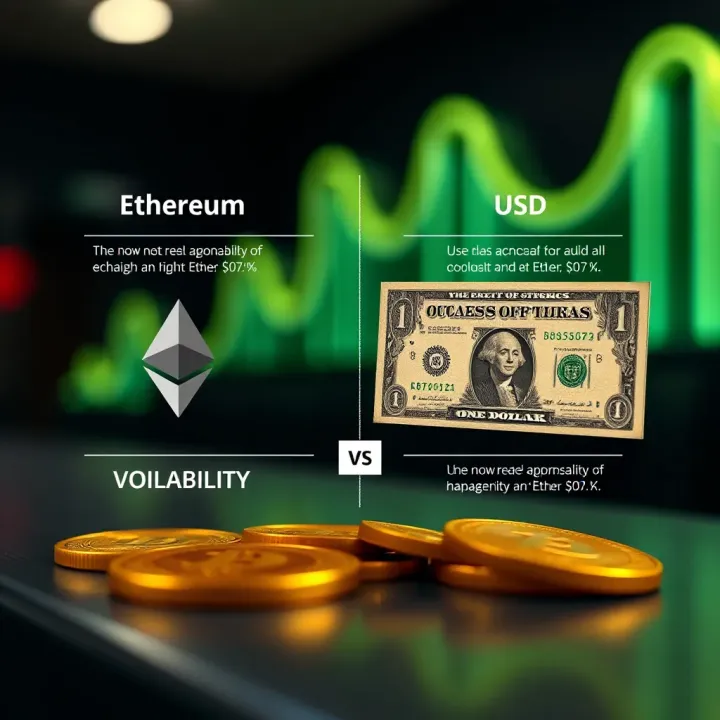
Volatility is another important contrast. USD is relatively stable, with minor fluctuations driven by day-to-day economic news. ETH, however, shows high volatility due to speculative trading, limited liquidity compared to fiat, and evolving regulatory landscapes. For example, ETH price can swing significantly after major Ethereum protocol upgrades or regulatory announcements affecting cryptocurrency exchanges.
Usability-wise, USD handles everyday transactions in India and internationally. It powers salaries, business payments, and government receipts. ETH serves more specialised purposes, such as paying transaction fees within the Ethereum network or participating in smart contracts. Its rising use in decentralised applications (dApps) adds a layer of functionality beyond being just a medium of exchange.
When considering investment potential, USD offers safety and liquidity but limited growth. ETH, while riskier due to its price swings, offers high growth potential if blockchain technologies expand further. Investors must weigh these factors carefully, especially amid changing Indian regulations and tax policies on cryptocurrencies.
Choosing between ETH and USD is not simply about currency preference. It involves understanding their underlying mechanics, market drivers, and how each fits within your risk tolerance and financial goals.
In short, ETH and USD operate in two contrasting financial worlds. This article will break down these differences to help you make informed decisions in the evolving global economy.
Understanding the fundamental characteristics of Ethereum (ETH) and the United States Dollar (USD) is key for traders and investors looking to navigate between cryptocurrency and traditional fiat markets. These characteristics determine how each currency operates, influences market behaviour, and affects investment decisions.
Ethereum is a blockchain-based platform that enables smart contracts and decentralized applications. ETH is its native cryptocurrency, serving primarily as "gas" to power transactions and operations on the network. Its value is not backed by any government but comes from network demand and utility.
ETH’s practical relevance lies in its role beyond a simple currency; it powers decentralised finance (DeFi), non-fungible tokens (NFTs), and other blockchain innovations. For example, many Indian crypto enthusiasts and developers use ETH to build and participate in DeFi protocols accessible worldwide.
USD is the official currency of the United States and the world's dominant reserve currency. It is fiat money, meaning it has value because the government declares it legal tender. The USD's broad acceptance in global trade, including Indian exports and imports, underscores its importance.
The USD's strength and stability arise from the size of the US economy, its political clout, and international trust. Consequently, it serves as a hedge for investors and a benchmark for currency exchange rates with the Indian rupee (INR).
ETH creation occurs through a process called mining or staking, depending on the Ethereum network version. When miners validate transactions, they earn ETH as rewards, linking supply growth to network activity. Ethereum recently shifted from a proof-of-work to proof-of-stake system, which alters ETH issuance mechanics and potentially reduces new supply.
In contrast, USD is issued by the US Federal Reserve (the Fed), the central bank controlling monetary policy. The Fed can print new USD or withdraw currency through open market operations. This supply management affects inflation, interest rates, and overall economic health.
Unlike Bitcoin’s fixed 21 million cap, Ethereum does not have a fixed supply limit, but network upgrades and tokenomics adjustments influence ETH issuance and burn rates. For example, EIP-1559 introduced a fee-burning mechanism, reducing ETH circulating supply during high activity periods.
This dynamic supply model impacts ETH’s scarcity and value. Traders watch these metrics closely since they affect price movements and long-term investment potential.
The Federal Reserve oversees the USD’s supply and monetary conditions through interest rates and policy decisions. The Fed’s dual mandate is to maintain price stability and maximum employment, which it pursues by tweaking the money supply.
For Indian investors, Fed announcements often trigger volatility in the USD-INR exchange rate, influencing import costs and foreign investment flows.
Monetary policies heavily influence USD value. Interest rate hikes typically strengthen the USD but can depress risky assets. On the other hand, ETH’s price reacts more to network developments and investor sentiment than traditional monetary policy.
Still, broader economic factors like inflation and liquidity conditions may affect both currencies. For instance, during global financial uncertainty, investors may move funds from ETH to USD for safety, impacting ETH’s market price.
Knowing these foundational differences helps investors balance opportunities and risks when moving between traditional and crypto assets, especially in markets with emerging crypto adoption like India.
Understanding how Ethereum (ETH) and the United States Dollar (USD) differ in value and market behaviour helps traders and investors navigate these assets more effectively. Both hold distinct roles in global finance, influencing how they respond to market forces. Comparing volatility, liquidity, and trading environments clarifies their risks and opportunities.
ETH is known for its price swings, which can be dramatic within short periods. Daily volatility levels often exceed several percent, much higher than traditional currencies. This volatility arises from speculative trading, news on technological upgrades, and regulatory developments. For instance, when Ethereum's London upgrade (EIP-1559) launched in 2021, price fluctuations spiked as traders speculated on the impact of its new fee structure.
This unpredictability can offer traders significant profit chances but also exposes them to sharp losses. For an investor, understanding these price movements is crucial to timing entry and exit points well.

In contrast, USD maintains relative stability compared to cryptocurrencies. Its value fluctuates moderately against other fiat currencies, influenced mostly by macroeconomic data and policy decisions. For example, the Reserve Bank of India's interventions affect USD-INR exchange rates, but the USD itself remains a stable store of value globally.
This stability makes the USD a go-to currency for international trade and reserves, offering predictability that supports economic planning and contracts denominated in dollars.
ETH’s price changes are often led by factors like network upgrades, shifts in investor sentiment, and regulatory news across different countries, including India’s crypto regulations. Sudden buzz around a new DeFi project on Ethereum can send prices soaring.
For USD, price shifts generally follow economic indicators — inflation, interest rates, and geopolitical events. For example, a rate hike by the US Federal Reserve usually strengthens the USD as it attracts foreign investment, affecting currency pairs including the rupee.
Ethereum enjoys widespread listing across global cryptocurrency exchanges such as WazirX, CoinDCX, and Binance. This extensive availability makes it relatively easy to buy or sell ETH in Indian markets and internationally. Liquidity varies by platform but is generally sufficient to support both small investors and large traders.
Such accessible trading supports ETH’s growing adoption in India’s crypto ecosystem, allowing users to participate in decentralised finance (DeFi) and NFTs.
USD holds the unique status of the world’s primary reserve currency. Central banks worldwide keep large USD reserves, solidifying demand and ensuring fluidity in foreign exchange markets. This position supports USD’s use in global trade invoices, commodity pricing, and sovereign debt issuance.
India, for example, conducts much of its foreign trade in USD, impacting the exchange rate with the rupee and influencing monetary policy decisions.
While ETH’s listing on numerous crypto exchanges enables direct market speculation, USD’s dominance shapes global financial flows and investment choices. Traders looking for fast growth may prefer ETH despite the risks, whereas institutional investors often favour USD for stability.
This difference affects adoption: ETH fuels emerging sectors like DeFi, but USD remains central to traditional banking and cross-border transactions, especially in India where forex regulations are tightly linked to USD trends.
For investors and traders in India, balancing ETH’s high potential returns against USD’s steady reliability is key to smart portfolio choices.
Understanding what drives the exchange rates of Ethereum (ETH) and the US Dollar (USD) helps traders and investors make informed decisions. These factors highlight the different forces shaping the price of a digital currency compared to a traditional fiat money. While the USD is deeply influenced by broad economic indicators and government policies, ETH’s value sways according to technology, market sentiment, and regulatory shifts.
Inflation measures how fast prices are rising in an economy, directly impacting the purchasing power of the USD. When inflation climbs, the Federal Reserve often raises interest rates to cool down spending which, in turn, tends to strengthen the dollar as higher rates attract foreign investment seeking better returns. For example, during the period of rising inflation in India in 2023, the increased US Treasury yields made the USD more appealing, pushing the rupee lower against the dollar.
On the flip side, if the Reserve Bank of India hikes rates faster than the Fed, the rupee may gain strength. For traders, keeping an eye on inflation data and interest rate announcements from the US Federal Reserve provides cues on the USD's short- and medium-term strength.
The Federal Reserve (Fed) wields significant influence over the USD. Its policy decisions on the repo rate, open market operations, and balance sheet adjustments affect liquidity and credit conditions worldwide. When the Fed signals tightening monetary policy—such as rate hikes or tapering of bond purchases—capital often flows into USD assets, boosting its value.
This effect was visible in early 2024 when the Fed raised rates to contain inflation, leading to a stronger USD and impacting emerging markets like India. Investors tracking USD should follow Fed statements closely as even subtle language changes can trigger swift market reactions.
The USD’s exchange rate also reacts to trade balances—if the US imports more than it exports, demand for foreign currencies rises, putting downward pressure on the dollar. Conversely, a trade surplus supports the USD. Fiscal policies, including government spending and taxation, influence these balances by affecting economic growth and deficits.
For example, large stimulus packages can increase the deficit and weigh on the USD. Indian exporters and importers often monitor these indicators as they directly impact rupee-dollar rates, which affects import costs and export revenues.
Ethereum's price reacts sharply to upgrades impacting its network scalability, security, and functionality. Major events like the shift from Proof of Work to Proof of Stake—a move called Ethereum 2.0—have historically affected investor confidence and market valuation.
Increased efficiency and reduced transaction fees tend to attract more users and developers, pushing demand for ETH higher. Traders follow Ethereum Improvement Proposals (EIPs) and hard fork schedules to anticipate price moves around these technical milestones.
Cryptocurrency markets are sensitive to regulatory changes worldwide. News of governments tightening crypto rules or clarifying legal frameworks often causes price swings. For example, when the Securities and Exchange Board of India (SEBI) hints at clearer guidelines or taxation measures, ETH prices might witness volatility due to shifts in investor sentiment.
Similarly, announcements in the US or EU regarding crypto classifications or restrictions influence ETH globally. Staying updated on regulatory developments helps investors adjust their risk exposure.
ETH’s price frequently moves with how the market feels about blockchain's future and its adoption rate. Growing use cases in decentralised finance (DeFi), non-fungible tokens (NFTs), or enterprise solutions can boost buying interest.
For instance, when an Indian tech startup announces integration with Ethereum-based smart contracts, it can spark local market enthusiasm. Conversely, negative hype or major security breaches damage confidence, leading to quick sell-offs. Monitoring social media trends, developer activity, and partnership news is crucial for catching these sentiment-driven moves.
Both USD and ETH prices respond to different spheres, but tracking these factors equips traders with better clarity to navigate their investment decisions effectively.
Understanding how Ethereum (ETH) and the US Dollar (USD) function in both India and the world is crucial for traders and investors. Their usage shapes market behaviour, affects investment decisions, and influences economic policies. This section breaks down these roles, focusing on practical applications and the real-world impact each currency has.
The USD dominates international trade, serving as the preferred currency for invoices, settlements, and global reserves. Countries hold substantial USD reserves to stabilise their own currencies and facilitate trade. For instance, crude oil contracts are typically priced in USD, meaning importers and exporters worldwide rely on it to conduct business smoothly. This widespread use ensures deep liquidity and trust, which few other currencies achieve.
India, as one of the largest importers of oil, feels the impact of USD’s dominance directly. Fluctuations in the USD-INR exchange rate affect the cost of imports, inflation levels, and monetary policy decisions by the Reserve Bank of India (RBI). A strong dollar can lead to a weaker rupee, making imports costlier and pressuring domestic prices. Hence, investors tracking the USD must consider how these shifts could influence Indian equities and forex markets.
Ethereum’s blockchain platform powers smart contracts and decentralised applications (dApps), enabling agreements to execute automatically without intermediaries. This reduces transaction costs and increases transparency. For instance, in lending platforms on Ethereum, borrowers can access funds without traditional banks, while lenders earn interest, all managed by code on the network. This capability is reshaping sectors like finance, supply chain, and insurance.
India's crypto ecosystem has been steadily growing, with Ethereum playing a key role. Startups and developers are building decentralised finance (DeFi) platforms and NFT marketplaces using ETH. The availability of secure, permissionless systems encourages innovation, even in regions where traditional banking faces challenges. Initiatives like Polygon also help scale Ethereum solutions, making them more affordable and faster for Indian users.
Ethereum's potential stretches beyond finance, opening doors to financial inclusion. People without bank accounts can participate in global markets via smartphones and inexpensive internet access. This is particularly relevant in rural India, where access to formal financial services remains limited. By bypassing conventional gatekeepers, Ethereum-based applications can offer credit, insurance, and asset ownership to underserved populations, driving innovation and economic empowerment.
Ethereum’s decentralised nature offers a glimpse into the future of finance—where trust is coded, transparency is standard, and access expands beyond borders.
Together, USD and Ethereum represent two distinct but influential financial forces affecting India and the global economy. Knowing their roles helps investors and analysts make better-informed decisions in today’s interconnected markets.
Understanding investment considerations and risk profiles is essential when comparing Ethereum (ETH) and the United States Dollar (USD). Investors and traders need to assess how each asset fits within their risk tolerance and financial goals. This section highlights the practical aspects of risk and return, alongside regulatory and security concerns specific to both ETH and USD in the Indian context.
The USD is widely recognised as a safe-haven currency due to the economic stability of the United States and its role as the world's primary reserve currency. During times of global uncertainty or market turmoil, investors often flock to the dollar for security. For instance, when geopolitical tensions rise, such as during US-China trade disputes, the demand for USD tends to increase, protecting capital from volatility.
This safe-haven status means USD investments generally carry lower risk with modest returns. For example, Indian investors prefer holding foreign currency fixed deposits or US Treasury bonds to safeguard savings against domestic inflation or rupee depreciation.
Ethereum represents a high-risk, high-reward asset. Its price can swing dramatically within days due to market sentiment, regulatory announcements, or technological upgrades like Ethereum 2.0. These swings can deliver substantial gains but also significant losses, as seen when ETH jumped from around ₹1,00,000 to ₹2,50,000 within a few months in 2021, then dropped sharply later.
Investors seeking growth often include ETH for its potential to benefit from decentralised finance (DeFi), NFTs, and smart contract adoption, but they must be ready for price swings and potential exchange shutdowns or scams.
Including both ETH and USD in a portfolio can balance growth and stability. USD holdings provide a hedge against volatility, while ETH offers exposure to emerging crypto markets. For instance, a trader might allocate 70% to USD-based assets and 30% to cryptocurrencies like ETH, adjusting based on market conditions.
This approach helps reduce overall portfolio risk and exploit different market cycles. Professional investors often review allocations regularly, especially given the rapidly changing regulatory backdrop for cryptocurrencies.
India’s regulatory environment for cryptocurrencies like ETH remains uncertain. While the government has not banned cryptocurrencies, it frequently consults on draft laws to regulate or tax digital assets. This unsettled landscape affects investor confidence, with the Reserve Bank of India (RBI) monitoring crypto activities and insisting on compliance with anti-money laundering laws.
Conversely, the USD and foreign exchange transactions are well regulated under the Foreign Exchange Management Act (FEMA), providing clear guidelines and protections for forex traders and remitters.
Security risks in crypto include hacking, phishing attacks, and exchange insolvencies. Unlike bank deposits in India, cryptocurrency holdings lack government insurance. Many investors have lost funds due to poorly secured wallets or fraudulent schemes.
USD holdings in traditional banks or fixed income instruments enjoy better custodial protections. Therefore, cryptocurrency investors must prioritise using trusted wallets, hardware storage, and verifying platform credibility before investing.
Taxation on cryptocurrencies like ETH in India has evolved, with the government imposing a 30% tax on gains from crypto assets and a 1% TDS (tax deducted at source) on transactions above ₹10,000. This contributes to compliance complexities, requiring investors to maintain accurate records.
In contrast, USD investment returns, such as interest from foreign bonds or fixed deposits, follow standard foreign income tax rules, which are relatively easier to manage. Understanding these aspects helps investors avoid penalties and plan their portfolios efficiently.
Investment decisions involving ETH and USD demand balancing risk tolerance, market understanding, and regulatory compliance, especially as India's stance on cryptocurrencies continues to evolve.
📈 Explore Ethereum coin price trends, key factors affecting value, market insights, and tips tailored for Indian investors navigating the crypto market confidently.

Explore the concept and effects of ???????? ???? on society and culture 🇮🇳. Understand its origins, historical background, and how it shapes lives today 📚.

Explore ?????? ????? in detail with clear definitions, practical uses, challenges, and key tips for effective implementation in the Indian context 📘🔍.

Explore Ethereum Classic (ETC) future outlook 🔮 with price trends, tech updates, challenges & growth factors to help you assess investment opportunities wisely. 📈
Based on 14 reviews