
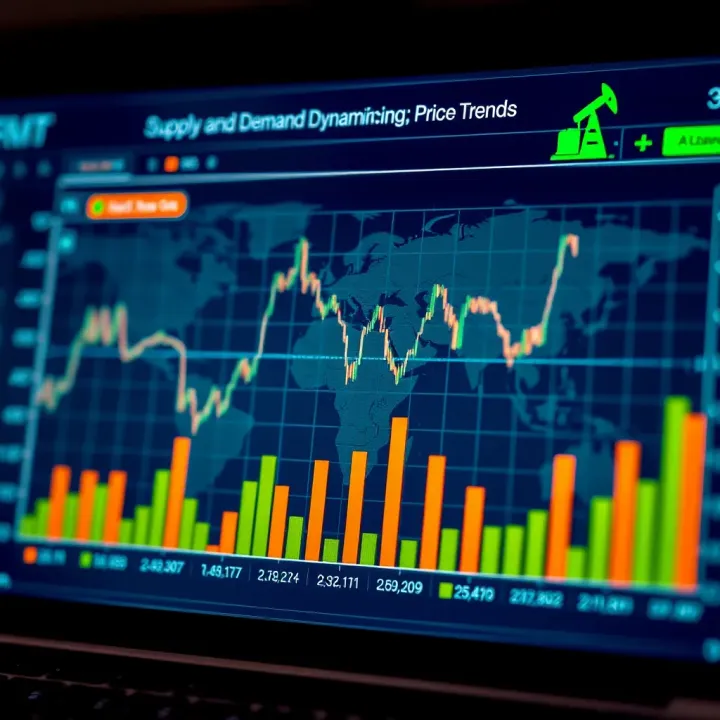
Crude Oil Price Prediction: Key Methods & Market Factors
🔍 Discover how crude oil price prediction methods consider supply-demand shifts, geopolitical events, and tech advances impacting India's energy markets and economy.
Edited By
Emily Carter
Price prediction refers to estimating the future prices of assets such as stocks, commodities, or retail goods. This process helps traders, investors, and analysts make better decisions in markets that are often unpredictable and volatile.
In India’s financial markets, price prediction plays a significant role due to rapid economic changes, government regulations, and international events impacting local prices. For instance, predicting the price of crude oil, which heavily influences petrol rates and inflation, can directly affect investment and policy decisions.

Price prediction uses various techniques, ranging from simple statistical models to advanced machine learning algorithms. Some common methods include:
Technical Analysis: Studying historical price charts and patterns to forecast future movements.
Fundamental Analysis: Evaluating economic indicators, company performance, and market conditions to assess an asset’s true value.
Sentiment Analysis: Tracking market moods through news, social media, and trader behaviour.
Accuracy in price prediction depends on factors like data quality, market stability, and method suitability. For example, in India’s stock markets, strong seasonal trends around festivals or budget announcements may improve prediction reliability, while sudden policy changes can cause unexpected price shifts.
Effective price prediction requires combining different methods with local market insights. Blind reliance on algorithms without understanding ground realities can lead to costly mistakes.
Practical applications in India span multiple sectors:
Stock Trading: Investors use price forecasts to time their buys and sales, aiming to maximise returns.
Commodity Markets: Farmers and traders predict crop prices to decide on sale time or storage.
Retail Pricing: Businesses anticipate demand and price fluctuations during festivals or sales seasons.
Understanding the basics of price prediction prepares market participants to better navigate risks and opportunities. The following sections explore these approaches in detail and share tips to improve forecasting outcomes especially suited to Indian market dynamics.
Price prediction is the process of estimating the future price of a financial asset or commodity based on historical data, market trends, and various influencing factors. It involves analysing patterns and applying statistical or computational models to forecast how prices might move. This practice helps traders, investors, and businesses plan their strategies by anticipating price changes rather than reacting after the fact.
Accurate price prediction benefits multiple sectors by guiding decision-making and risk management. For instance, investors rely on forecasts to optimise portfolio returns, while commodity producers set production levels based on expected price shifts. Retailers adjust pricing to stay competitive, and real estate developers plan project launches according to market trends. In the Indian context, understanding monsoon patterns or government policies can significantly affect price movements in agriculture and housing. Market participants reduce uncertainties by using price forecasts, improving overall efficiency.
Stock price prediction plays a critical role for investors and traders looking to capitalise on market movements. In India’s dynamic stock markets, timely predictions enable participants to identify buying or selling opportunities. For example, anticipating the quarterly earnings impact on a company like Tata Steel’s stock price helps investors decide when to enter or exit positions. Day traders often rely on short-term price forecasts using technical indicators, while long-term investors look at broader economic trends and company fundamentals.
Commodities such as crude oil, gold, and agricultural produce have prices influenced by both local and global factors. In India, predictions around staple crops like wheat and rice impact farmers, traders, and government procurement policies. For example, knowing the expected price of sugar before the harvest season helps sugar mills plan purchases and Telangana’s sugarcane farmers manage their credit needs. Similarly, fuel price forecasts affect transport costs and inflation. Accurate commodity price prediction supports supply chain management and budgeting across sectors.
Real estate price forecasting informs developers, buyers, and investors about future market conditions. Cities like Mumbai and Bengaluru see constant fluctuation based on demand, infrastructure developments, and regulatory changes. For example, anticipating price appreciation in emerging suburbs guides builders on land acquisition timing, while homebuyers use forecasts to decide when to invest for better value. Trends in interest rates and policy measures such as RERA (Real Estate Regulatory Authority) also shape price movements and need to be factored into predictions.

Retail pricing prediction helps businesses optimise inventory and sales strategies amid competitive pressures. In the Indian retail scene, factors like festive season demand, supply disruptions, and consumer behaviour shape product prices. For instance, predicting price trends for electronics during Diwali sales determines discount strategies on platforms such as Flipkart and Amazon India. Smaller retailers in tier-2 and tier-3 cities would also benefit by adjusting prices dynamically based on expected demand and competitor moves. Accurate retail price prediction can improve margins and customer satisfaction alike.
Predicting prices is not about certainty but giving you an informed edge to navigate markets better. Each type of price has its nuances, and understanding these basics sets the foundation for effective forecasting.
Price prediction relies heavily on the methods and techniques used to process past data and forecast future values. These techniques matter because they directly impact the accuracy and usefulness of predictions, influencing decisions in trading, investment, or pricing strategies. For instance, a day trader in Mumbai might use time series analysis to anticipate stock price swings, while a farmer may benefit from AI models forecasting commodity prices during monsoon season.
Time Series Analysis involves studying a sequence of data points recorded over regular time intervals, such as daily stock prices or monthly gold rates. The idea is to identify patterns like trends or seasonal effects, which can help predict future prices. For example, if the price of onion shows a consistent rise during festival seasons in India, time series models can quantify and forecast this pattern, aiding traders and sellers to plan better.
Regression Models are used to understand the relationship between a dependent variable (price) and one or more independent variables. In price prediction, regression can help identify how factors like interest rates, inflation, or crude oil prices affect asset prices. For example, an analyst might use regression to see how changes in RBI’s repo rate influence real estate prices in Bengaluru. This helps in quantifying impacts, making forecasting more systematic.
Neural Networks mimic human brain function to detect complex patterns in data, making them suitable for nonlinear price movements. They excel in handling large datasets, such as stock price histories, economic indicators, and news sentiment. For instance, a neural network might analyse years of NSE data, detecting subtle market signals that traditional models miss.
Decision Trees split data into branches based on feature values, making predictions by following a path of conditions. This approach is easy to interpret and useful in spotting key price influencers. For example, a decision tree might separate stock price movements based on company earnings, sector performance, and market trends, helping investors to understand which factors matter most.
Support Vector Machines (SVM) classify data by finding the best boundary separating price increase or decrease scenarios. SVMs are effective when the relationship between variables isn’t straightforward. For example, in predicting commodity prices like turmeric, SVM can classify price trends based on weather patterns, export policies, and storage conditions.
Fundamental analysis looks at economic, financial, and industry data to estimate intrinsic value, while technical analysis focuses on price and volume charts to identify trading opportunities. Traders commonly combine both for a balanced view—for example, using company quarterly results alongside moving averages and Relative Strength Index (RSI) charts to time investments better.
Understanding and selecting the right method depends largely on the type of price data, market conditions, and the specific objectives of prediction. Blending multiple approaches often improves the robustness of forecasts in India’s diverse markets.
Accurate price prediction depends on several key factors that traders, investors, and analysts must carefully evaluate. Understanding these elements helps avoid costly mistakes and improves decision-making quality.
Market volatility—how much prices fluctuate over time—directly affects prediction reliability. Sudden events like government policy changes, geopolitical tensions, or natural disasters can disrupt expected trends. For instance, during the 2020 monsoon season, unpredictable rainfall patterns caused sharp fluctuations in agricultural commodity prices such as pulses and oilseeds, complicating forecasts. Similarly, unexpected RBI interest rate decisions can cause rapid shifts in stock prices, making predictions less dependable.
Reliable predictions need clean, timely, and comprehensive data. Poor-quality data—containing errors or gaps—can throw models off, leading to inaccurate forecasts. For example, using outdated sales figures in retail price prediction fails to capture current market sentiment. In India, where informal markets exist alongside formal ones, data completeness is a challenge. Access to real-time data from stock exchanges like NSE and BSE, or commodity platforms such as NCDEX, significantly improves accuracy. More extensive historical datasets allow models to capture seasonal trends and demand cycles, enhancing prediction quality.
Choosing the right prediction model is vital. Simpler models like linear regression suit stable markets but may fail when price behaviour is complex. Advanced machine learning methods can capture nonlinear patterns but risk overfitting—where a model fits the training data too closely and performs poorly on new data. For example, a decision tree trained on past stock trends might excel at predicting known patterns but struggle when unexpected market shocks occur. Regular model validation and testing with fresh data sets prevent overfitting and improve robustness.
Traders and analysts should treat predictions as one input among many, not absolute truths. Understanding the influence of market volatility, data quality, and model choice guides better risk management and investment strategies.
By focusing on these factors, professionals can enhance the precision of price forecasts and navigate the uncertainties inherent in Indian markets more effectively.
Price prediction plays a significant role in shaping decisions across various Indian sectors, where market dynamics and local peculiarities add layers of complexity. By forecasting prices, traders, investors, and businesses can better navigate volatility, optimise strategies, and reduce financial risks. The benefits extend beyond wealth creation to include efficient resource allocation and consumer benefit. India's diverse economy offers unique contexts where price prediction tools directly influence outcomes.
In India, forecasting stock prices helps investors make educated choices on when to buy or sell shares, balancing risk and reward. Tools such as technical analysis, combined with machine learning models, assist in predicting trends for stocks like Reliance Industries, Tata Motors, or Infosys. For instance, investors often use price predictions to time entries during volatile periods in indices like the Sensex or Nifty 50. These predictions guide portfolio rebalancing and support the decision-making process when assessing new investment opportunities or exiting positions.
Accurate stock price prediction can mean the difference between gains and losses, especially for day traders and short-term investors who rely on timely insights.
Price prediction is crucial in India's agriculture sector, where factors like monsoon patterns and government policies heavily influence rates. Forecasting prices for commodities such as wheat, rice, cotton, and spices helps farmers decide the best times to sell and plan crop schedules. Agencies use market data combined with weather forecasts and supply-demand analysis to offer price outlooks. This information assists traders in commodity markets and helps agricultural cooperatives manage procurement efficiently, reducing wastage and ensuring fair prices for farmers.
Retail businesses in India increasingly depend on price prediction to adjust prices dynamically according to demand, seasonality, and competition. Platforms like Flipkart and Amazon India use predictive analytics to set prices that maximise sales and profits while catering to the price sensitivity of Indian consumers. Understanding when to offer discounts during festive sales or manage inventory during monsoon slowdowns can improve customer satisfaction and boost turnover. Consumer behaviour analytics, combined with price forecasts, allow retailers to anticipate trends and tailor marketing campaigns.
Price prediction in India is more than forecasting numbers—it is a practical tool that directly impacts financial outcomes and operational success across industries. Trading and investing, agriculture, and retail sectors benefit substantially by adapting their strategies based on reliable price forecasts suited to the Indian market environment.
Price prediction is never a straightforward exercise. Despite the best models and vast data, various challenges affect the accuracy and usefulness of forecasts. Recognising these limitations helps traders, investors, and analysts manage expectations and use predictions more effectively.
Sudden, unforeseen events can disrupt markets instantly, making even well-tested models obsolete overnight. For instance, the COVID-19 pandemic caused rapid swings in stock markets and commodities worldwide. In India, disruptions in the agricultural supply chain during lockdowns led to price volatility that defied usual seasonal patterns. These shocks often emerge from geopolitical crises, natural disasters, or unexpected policy changes, and no model can predict them with certainty. Thus, traders should maintain risk buffers and avoid overreliance on forecasts during turbulent times.
Bias creeps into price prediction models through data selection, algorithm design, or analyst assumptions. For example, if an algorithm feeds on historical stock data without factoring in sector-specific disruptions, it might favour earlier trends that no longer hold true. Moreover, ethical issues arise when predictions influence market behaviour or create unfair advantages. Hype around certain cryptocurrencies or stocks can lead to manipulations based on selective forecasts. Transparency about data sources and methodologies is critical to maintain trust and avoid harmful market distortions.
Price predictions are best viewed as informed estimates, not certainties. Overconfidence in precise figures can mislead decision-making. For instance, a forecast that a stock will hit ₹1,200 in six months should be treated as a guidance range rather than a fixed destiny. Analysts must communicate the confidence intervals and underlying assumptions clearly. Combining multiple prediction methods and continuously updating them with fresh data usually results in better outcomes. Importantly, traders should correlate predictions with broader market indicators and their own judgement.
Ultimately, price prediction tools are aids, not crystal balls. Knowing their challenges and limits allows you to harness their insights effectively while avoiding pitfalls.
Understanding these key points enables financial stakeholders to use price prediction sensibly, balancing optimism with caution. This balanced approach aligns well with the often volatile and dynamic nature of Indian markets.
🔍 Discover how crude oil price prediction methods consider supply-demand shifts, geopolitical events, and tech advances impacting India's energy markets and economy.

📊Get tomorrow's Dogecoin price insights with analysis of market trends, technical signals & latest news. Stay ahead in crypto trading with expert factors to watch!🚀

📈 Discover tomorrow's BNB price outlook with insights on market trends, expert views, and risks. Stay informed before you trade or invest in Binance Coin now!

Learn how Binance Coin (BNB) price is converted to ₹INR, discover factors impacting its value, methods to track price changes, and key risks in Indian trading 🪙📈
Based on 8 reviews