
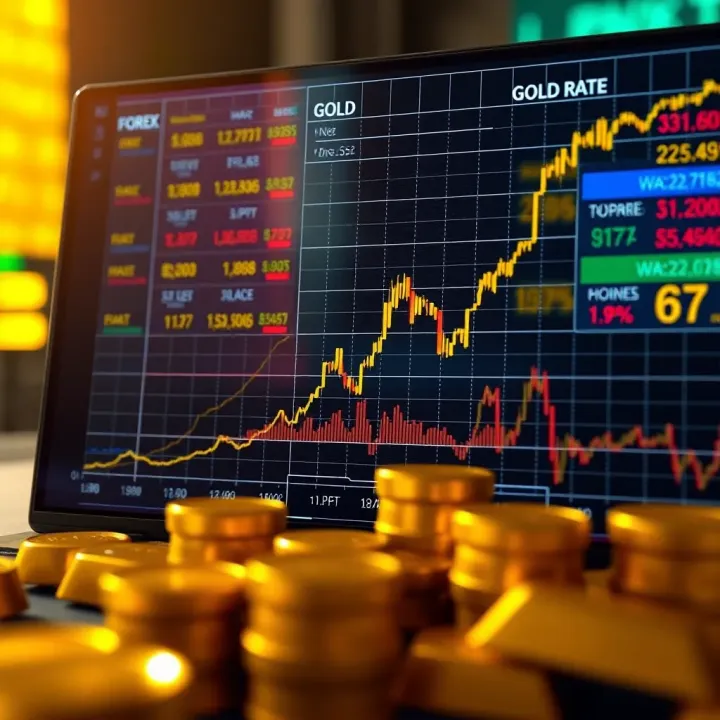
Understanding Forex Gold Rate for Indian Investors
💰Understand how forex gold rates impact your investments in India. Learn how currency shifts direct gold prices & key factors to watch. Navigate wisely!📈
Edited By
Isabella Hughes
Predicting the gold rate for the next day requires a clear understanding of varied economic and market factors. Gold prices rarely move randomly; they respond to specific triggers that traders and investors must watch closely. In India, where gold plays a key role in personal savings and investment, even a small change in price can significantly impact buyers and sellers.
This section introduces the core elements that influence gold’s daily value. Factors such as global currency trends, especially the US dollar, have immediate effects on gold prices in the Indian market. For instance, when the dollar strengthens, gold generally becomes costlier in rupees, often pushing prices higher.
Besides currency movements, government policies in India – like customs duty adjustments or import regulations – directly influence gold’s retail price. This connection is crucial because most gold in India is imported, and any change in import duties reflects quickly in local prices.
Economic data releases, including inflation figures, industrial production, or interest rate decisions by the Reserve Bank of India (RBI), also shape market sentiment. Gold often acts as a hedge against inflation, so rising inflation trends typically boost demand and prices.
Understanding how these factors interact helps create more reliable predictions, rather than relying on guesswork or historical averages alone.
To forecast tomorrow's gold price, traders combine technical analysis with the interpretation of economic indicators and global events. Technical charts reveal support and resistance levels, while news on geopolitical tensions or a sudden spike in oil prices can rapidly shift market dynamics.
In India, temple jewellery demand and festival seasons add an additional layer influencing gold consumption and pricing. For example, prices often show incremental rises ahead of Diwali or Akshaya Tritiya due to increased buying pressure.
In summary, accurate prediction blends analysis of:
Currency exchange rate trends, especially USD/INR
RBI policies and domestic economic indicators
Global geopolitical events
Seasonal buying patterns
Focusing on these aspects provides a grounded approach to forecasting gold prices, helping investors and traders make informed decisions backed by data and relevant market movements.
Grasping how gold prices move is essential for anyone involved in trading or investing, especially if you want to predict tomorrow's rate accurately. Gold doesn't behave like most commodities; its value hinges on a mix of domestic supply-demand factors, international trends, and currency values. Understanding these forces helps you make better calls rather than just guessing.
Domestic demand and supply dynamics play a big role in gold pricing within India. A significant chunk of demand comes from the wedding and festival seasons, such as around Diwali, when people buy jewellery in large volumes. When local demand spikes, especially if mining and imports lag behind, prices tend to firm up. Conversely, if imports increase or the government eases import duties, supply expands and prices might moderate. For example, a surprise import duty cut by the government can soften gold prices, even if global rates remain steady.
International market influences affect domestic gold rates significantly because India imports nearly all its gold. Factors like the US Federal Reserve’s policies, global economic uncertainty, or demand from major buyers such as China impact the international gold price, which then feeds into India’s rates. A fresh geopolitical event, like tensions in the Middle East, could push global gold higher as investors seek safety, consequently pushing up Indian gold prices as well.
Currency fluctuations, especially INR-USD rates, have a direct impact on gold's domestic cost. Since gold is priced globally in US dollars, when the rupee weakens against the dollar, gold becomes pricier in India even if the international gold price holds steady. For example, if the INR drops from ₹75 to ₹77 against the dollar, gold prices in India can rise roughly by 2-3%, reflecting the increased import cost. Traders often watch currency pairs closely because small movements can change profit margins on trading gold significantly.
Impact of inflation and interest rates is a key consideration for gold prices. Gold traditionally acts as an inflation hedge, so when inflation rises, investors flock to gold to preserve their purchasing power. Similarly, if interest rates are cut by the Reserve Bank of India (RBI) or globally, gold becomes more attractive because its opportunity cost falls relative to fixed-income assets. For instance, during a period of rising inflation and falling interest rates, gold prices are likely to rise as well.
Effect of global economic data releases such as US Non-Farm Payroll numbers, inflation statistics, or GDP growth figures can sway gold prices quickly. Positive economic data might weaken gold as investors prefer riskier assets, while weak data often push gold higher due to safe-haven demand. Traders in India track these releases carefully, as sudden announcements can cause sharp intraday movements in gold rates. This makes it important to follow economic calendars and assess how global sentiment might shift tomorrow’s price.
Understanding these aspects not only sharpens your prediction skills but also helps you act confidently during volatile periods where multiple factors interplay to shape gold prices.
This knowledge is the foundation for effective forecasting and strategic decision-making in gold trading and investment.

Accurately predicting gold rates for the next day helps traders and investors make timely decisions and manage risks better. This process combines various methods, mainly technical and fundamental analysis, each offering unique insights. By using these approaches, one can anticipate market movements with some confidence, essential for navigating volatile commodities like gold.
Technical analysis often starts with chart patterns and trend lines. These visual tools help identify the direction and strength of price movements by studying past data. For instance, an upward trend line drawn below successive lows indicates sustained buying interest, hinting that gold prices may continue to rise in the short term. Conversely, a head and shoulders pattern might signal an impending decline. Traders often use such patterns to set entry and exit points. In India, many active gold traders study charts on platforms like NSE or MCX commodity segments daily to catch these signals.
Moving averages smooth out price fluctuations, revealing overall direction. The most common are the 50-day and 200-day moving averages. When the shorter average crosses above the longer one, it's a bullish sign, suggesting prices could climb the next day. The Relative Strength Index (RSI) measures momentum, indicating overbought or oversold conditions. An RSI above 70 typically signals gold may be overbought, warning of a possible price correction soon. Combining moving averages and RSI provides a clearer picture of market sentiment and price readiness for a move.
Gold generally reacts to geopolitical uncertainties since it is considered a safe-haven asset. Sudden political tensions like border skirmishes or diplomatic conflicts increase demand, pushing prices up. For example, a fresh flare-up along the India-Pakistan border tends to spike gold rates in Indian markets the following day as investors seek security. Hence, closely watching news feeds about geopolitical developments gives an edge in predicting next-day price changes.
Global market sentiment affects gold rates significantly. When stock markets wobble or inflation fears rise, investors often rush to gold, boosting its price. Conversely, strong stock market rallies might reduce this demand. Keeping an eye on indicators such as the US dollar's strength, global equity indices, and crude oil prices helps gauge sentiment. For instance, a weakening dollar typically supports gold prices. Traders relying on this approach will watch international news and financial reports to anticipate how global moods might move the price tomorrow.
Combining technical and fundamental methods provides a practical roadmap to predict gold rates. While charts reveal patterns, fundamental cues offer context, together aiding better decision-making in the fast-moving market.
Global events play a direct role in shifting gold prices. For traders and investors, staying tuned to international developments can provide an edge in anticipating tomorrow's gold rate. These events influence both demand and supply expectations, impacting India's gold market even when the changes happen thousands of kilometres away.
Gold generally has an inverse relationship with the US dollar. When the dollar strengthens, gold prices tend to drop, and vice versa. This happens because gold is priced in dollars globally, so a stronger USD makes gold more expensive for holders of other currencies, reducing demand. For example, if the USD gains strength overnight due to a positive US jobs report, Indian gold traders might see a dip in local gold rates the next day.
Understanding this correlation helps buyers and sellers time their trades better. Since INR-USD exchange rates also fluctuate with the dollar, a stronger dollar usually translates to higher gold prices in India, even if the global spot price remains stable.
Oil prices indirectly shape gold rates by affecting inflation expectations. When crude oil prices rise, transportation and manufacturing costs go up, pushing inflation higher. Investors tend to flock to gold as a hedge against inflation, boosting demand and raising prices.
Consider the recent surge in global crude oil rates due to supply constraints; this led to inflation worries that pushed gold rates up. For Indian investors, watching daily oil price movements can signal inflation trends that influence gold prices overnight.
Periods of political instability or conflict increase gold’s appeal since it acts as a safe-haven asset. For instance, heightened tensions in the Middle East or unexpected geopolitical skirmishes can push gold prices up sharply. Traders anticipating such events often position themselves ahead to benefit from price jumps.
In India, where gold holds cultural and financial significance, local market sentiment can get affected rapidly by global political news. This means sudden events can change tomorrow's gold rate even before Indian economic signals come into play.
Changes in global trade policies or sanctions can disrupt supply chains and international commodity flows, affecting gold prices. For example, sanctions on countries rich in gold mining can limit supply, driving prices higher.
Similarly, tariffs or export restrictions imposed by major economies impact gold's availability and cost. It's important for investors and brokers in India to monitor announcements from entities like the World Trade Organization or major trade partners to predict potential short-term gold price movements.
Keeping an eye on global currency trends, commodity prices, and geopolitical news is key to forecasting tomorrow's gold rate effectively. Even slight shifts can ripple across markets and influence Indian gold prices rapidly.
Monitor USD strength and INR exchange rates
Track daily crude oil price movements for inflation signals
Watch geopolitical hotspots for sudden risk spikes
Stay updated on trade policy changes and sanctions
Being aware of these factors allows traders and investors to make more informed decisions instead of reacting after price changes occur.
Following practical tips to track and access gold rates helps investors and traders make timely moves in the precious metals market. Since gold prices can fluctuate within hours due to economic data, geopolitical events, or even currency shifts, getting real-time, accurate information is key to avoid losses and seize opportunities.
Indian markets and commodity exchanges play a central role in providing trusted gold prices. Exchanges like the Multi Commodity Exchange (MCX) and the National Commodity & Derivatives Exchange (NCDEX) offer real-time price feeds that reflect actual market sentiment and trade volumes. These platforms also show futures contracts prices, helping traders gauge market expectations. For example, during wedding season in India, sudden jumps in Indian demand reflect quickly in these exchanges, something investors should monitor closely.
Another dependable source is the Bombay Bullion Association and the Bullion Association of India, which publish domestic gold rates daily based on Mumbai’s local market, one of the major hubs for gold trade in India. Prices indicated here often include local taxes, making them practical guides especially for buyers in tier-1 and tier-2 cities.
Online platforms and mobile apps bring convenience to monitoring gold prices anytime, anywhere. Platforms such as the MCX app, Moneycontrol, and Bloomberg Quint provide live updates, historical charts, and market news specifically for Indian users. These apps help you customise alerts based on price thresholds or percentage movements, so you don’t miss an opportune moment.
Mobile wallets like PhonePe and Google Pay have also integrated gold-buying options with live prices, which is useful for users looking to invest small amounts regularly. This real-time access coupled with transaction ease suits retail investors who want to keep track without constant manual checking.
Timing purchases around predicted trends can improve your returns significantly. If analysis points to a dip tomorrow due to a strengthening rupee or easing inflation fears, deferring a purchase till then could save you thousands. Conversely, if political tensions raise safe-haven demand pushing gold prices up, buying earlier might be wise. Traders often watch overnight international cues and currency movements to predict the day’s price direction in India.
Considering local taxes and making cost-effective choices is often overlooked but critical. Gold in India attracts GST (currently 3%) on making charges and local state taxes on the total purchase value. These taxes vary by state, so checking the total cost in your state before buying helps avoid surprises. For example, buying from hubs like Delhi or Mumbai might be cheaper after considering local levies compared to smaller towns.
Also, opting for hallmarked jewellery and certified coins ensures you get the exact purity measured by verified standards, avoiding hidden costs from lower purity or adulteration. Planning your purchase during festive-season sales or taking advantage of EMI options on trusted e-commerce portals can further optimise your investment.
Staying informed using reliable sources and carefully timing your purchase with prediction insights can make a notable difference in gold investment returns while managing risks effectively.
💰Understand how forex gold rates impact your investments in India. Learn how currency shifts direct gold prices & key factors to watch. Navigate wisely!📈
Explore Bitcoin's future price trends 📈, key drivers like regulations, tech upgrades, and investor interest. Get expert insights & risk factors before investing 💡.
📉 Get a detailed AUD/USD forecast analysing economic data, geopolitical effects, and technical trends influencing the exchange rate between Australian and US dollars.
📊 Stay updated with today's EUR/USD forecast including key economic data from the Eurozone & US, market trends & expert views shaping currency moves.
Based on 6 reviews