

Understanding QX Trading Explained
📊 Explore QX trading: key features, platforms, risks & benefits explained. Understand its role in financial markets for smarter investing decisions in India.
Edited By
Liam Walker
Derivative trading is a powerful yet complex area of finance where contracts derive their value from the performance of underlying assets like stocks, commodities, currencies, or indices. In India, this kind of trading mainly happens on recognised exchanges such as the National Stock Exchange (NSE) and Bombay Stock Exchange (BSE), regulated by the Securities and Exchange Board of India (SEBI).
At its core, derivative trading allows investors to speculate on price movements or hedge existing positions, aiming to protect themselves from market risks. For example, a farmer might use futures contracts to lock in the price of wheat ahead of harvest, securing income even if market prices later fall. Meanwhile, a trader might buy a call option on Reliance Industries shares anticipating a price rise, paying only a fraction of the cost to own the stock outright.
There are several basic types of derivatives frequently used in the Indian market:
Futures: Agreements to buy or sell an asset at a predetermined price and date. These are standardised contracts traded on exchanges.
Options: Contracts that give the right, but not the obligation, to buy (call) or sell (put) an asset before expiry.
Swaps: Mainly over-the-counter agreements exchanging cash flows or risks, less common for retail investors.
Understanding these instruments helps traders manage risk or seek profit from market movements. However, derivatives carry risks such as leverage, which can amplify both gains and losses. For instance, small price swings in underlying assets can lead to large changes in contract value, sometimes wiping out an investor's margin.
Remember: While derivatives can offer strategic opportunities, they require careful study and clear risk management.
In India, SEBI lays down rules around margin requirements, contract specifications, and trading hours to promote transparency and protect investors. Knowing these regulations ensures you stay compliant and avoid common pitfalls.
This guide aims to break down derivative trading into actionable insights. Whether you are a stockbroker advising clients, a day trader seeking quick profits, or a financial analyst analysing market trends, understanding derivative mechanics will help you navigate the Indian markets confidently and prudently.
Derivative trading plays a significant role in modern financial markets, especially in India where markets are growing fast. Understanding the basics offers practical benefits to investors and traders alike. It helps safeguard portfolios against sudden price movements and opens avenues for making profits through various strategies. Whether you're a day trader eyeing quick gains or a long-term investor guarding against risk, this introduction lays down the foundation you need.
Derivatives are financial contracts whose value depends on an underlying asset like stocks, commodities, currencies, or indices. They don't represent ownership but derive their worth from these assets' price movements. For example, a futures contract on Nifty 50 is based on the index's current and expected values. Traders use derivatives to bet on or protect against those price changes without holding the asset itself.
The key difference between derivatives and their underlying assets is ownership and exposure. Owning shares of Reliance Industries means you have equity rights and possibly dividends. But a derivative contract based on Reliance shares only reflects the share price changes, not ownership. This makes derivatives more flexible and often cheaper to trade, but they also carry risks like leverage and counterparty defaults.
Derivatives act as a shield against price volatility. For instance, a farmer growing wheat can sell futures contracts on the commodity exchange to lock in a price before harvest. This protects against sudden price drops during the selling season. Similarly, companies with foreign currency exposure use currency futures to fix exchange rates, avoiding currency risk.
Traders can also use derivatives to speculate and make profits by predicting price movements. Unlike buying the actual asset, derivatives often require less capital thanks to margin trading. Suppose a trader expects crude oil prices to rise; buying call options on crude futures lets them gain from the price hike without paying full value upfront. This potential to amplify gains attracts speculators but comes with higher risk.
Derivatives contribute to efficient markets by improving price discovery. Futures and options prices reflect collective expectations about the underlying asset's future value. This information passes on to spot markets, leading to better pricing and liquidity. For Indian markets, active derivatives trading on platforms like NSE ensures transparent pricing, benefiting everyone from investors to businesses.
Understanding derivative trading is not just for experts; it's essential for anyone active in Indian financial markets to manage risk and spot opportunities more wisely.
Understanding the various types of derivative instruments is essential for anyone looking to trade or invest in these contracts. Each instrument offers different features and suits distinct trading strategies. Knowing their practical applications helps traders and investors choose what fits best in terms of risk profile, market exposure, and investment goals.
Futures contracts are standardised agreements to buy or sell an asset at a predetermined price on a specific future date. The standardisation ensures all contract terms—such as quantity, quality, and settlement date—are fixed by the exchange. This makes futures highly liquid and easy to trade as participants need not worry about negotiating contract details.
Settlement for futures usually happens through mark-to-market (MTM) daily. This means gains or losses are settled every day, reducing credit risk. For instance, if you hold a futures contract on Nifty 50 and the index moves favourably, your gains are credited daily to your account.
In India, futures contracts on indices like the Nifty 50 and on individual stocks such as Reliance Industries or Tata Motors are actively traded on the National Stock Exchange (NSE) and Bombay Stock Exchange (BSE). These contracts help traders hedge against market risks or speculate on price movements efficiently. For example, a hedger expecting a rise in crude oil prices might use futures to lock in current rates.
Options give the buyer the right, but not the obligation, to buy (call option) or sell (put option) an underlying asset at a specified price before expiry. Call options benefit when prices rise, while put options gain when prices fall. Unlike futures, options provide flexibility by limiting potential loss to the premium paid.
Buyers of options pay a premium upfront and are not obliged to exercise the contract if the market moves unfavourably. Sellers (writers) of options, however, have the obligation to honour the contract if exercised. This dynamic means option sellers take on more risk but earn premiums in return.
For instance, an investor expecting a stock to rise but wanting to limit risk might buy a call option instead of directly buying shares. On the other hand, a trader expecting limited price changes may sell call options to earn premium income, accepting the risk of potential loss if prices spike.
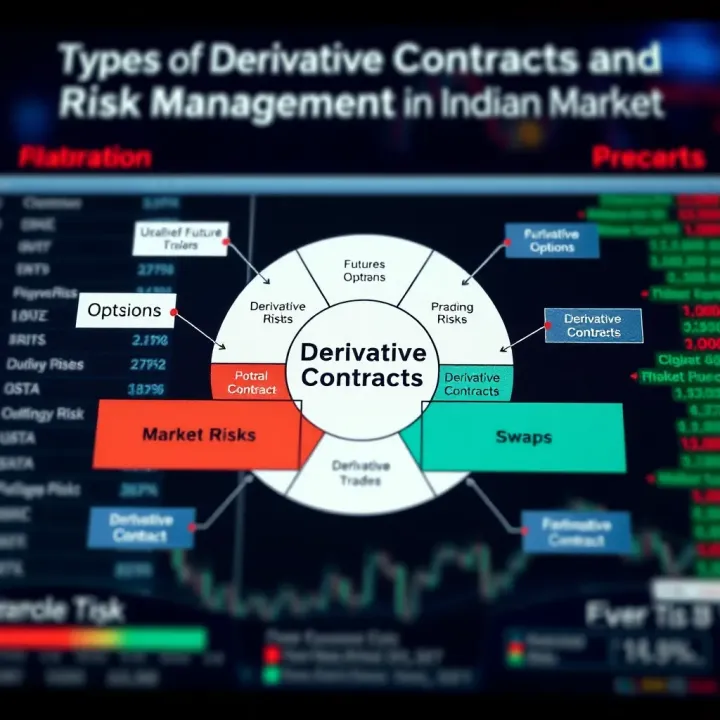
Swaps and forwards are customised contracts traded mostly over-the-counter (OTC). Swaps involve exchanging cash flows or obligations—such as interest rate payments—between parties. Forwards are agreements to buy or sell assets at a future date, but unlike futures, they are not standardised and lack exchange backing.
In Indian financial markets, swaps are used extensively by banks and corporates to manage interest rate or currency risks. Forwards find practical use in currency hedging by exporters and importers. This flexibility helps companies protect themselves against adverse price or rate movements specific to their needs.
Knowing these types of derivative instruments equips you to tailor your trading or hedging strategy effectively. While futures and options offer standardised, exchange-traded products suitable for traders and investors, swaps and forwards provide custom solutions primarily for institutional participants.
Understanding these tools aids in navigating risks and seizing opportunities across diverse Indian market conditions.
Understanding how derivative trading functions in real markets helps investors and traders grasp practical applications beyond theory. This knowledge proves vital for evaluating risks, spotting opportunities, and choosing the right strategies in India’s fast-evolving financial landscape.
Hedgers and their strategies
Hedgers use derivatives mainly to protect themselves against price fluctuations. For instance, a wheat farmer in Punjab might sell futures contracts on the National Commodity and Derivatives Exchange (NCDEX) to lock in a price for their produce. This shields the farmer from losses if wheat prices fall before the harvest. Similarly, companies importing crude oil use futures to fix costs, safeguarding budgets from volatile international prices. Hedging reduces uncertainty for businesses tied directly to commodities or currencies.
Speculators and risk appetite
Speculators accept higher risks to profit from market movements. They buy or sell derivatives based on expected price changes without any intent to directly use the underlying asset. For example, a trader on the National Stock Exchange (NSE) might buy call options on Reliance Industries shares anticipating a rise in price. Since derivatives allow leverage, speculators can control larger value positions with relatively small capital. However, this amplifies both potential gains and losses, so managing risk is critical.
Arbitrageurs' role
Arbitrageurs exploit price differences between related markets to earn risk-free profits. Suppose the futures price of a stock on NSE differs significantly from its spot price on the Bombay Stock Exchange (BSE). An arbitrageur would buy the cheaper and sell the dearer simultaneously, profiting as prices converge. This activity helps balance prices across markets, enhancing overall efficiency and liquidity.
Trading on NSE and BSE
Most derivative trading in India happens on NSE and BSE. Both offer electronic platforms with high liquidity and transparent pricing. These exchanges facilitate standardised futures and options contracts across various asset classes like equities, indices, and commodities. Traders benefit from easy access, real-time data, and a regulated environment that mitigates counterparty risks.
Order types and execution
Traders can use different order types such as market, limit, and stop-loss orders to control trade execution. For instance, a limit order lets a trader specify the maximum price they will pay or the minimum price they will accept, useful during volatile hours. Efficient order execution on NSE and BSE platforms ensures timely filling of orders, crucial given the fast pace of derivative markets.
Margin requirements and leverage
Derivative trading requires margins—initial deposits to cover potential losses—set by SEBI and exchanges. For example, trading Nifty futures may require a margin of around 10-15% of the contract value. Leverage arises because margins cover only a fraction of the position’s worth, allowing traders to amplify returns. Yet, this also increases the risk of margin calls and forced liquidation if prices move against the trader.
Mark to market settlements
At the end of each trading day, derivative positions are adjusted to reflect current market prices, a process called mark to market (MTM) settlement. If a trader’s position gains value, profits are credited to their account; losses require margin top-ups. This daily settlement reduces credit risk and ensures the market remains solvent.
Physical delivery vs cash settlement
Derivatives may settle either by physical delivery of the underlying asset or by cash payment. In India, most equity index derivatives like Nifty settle in cash, as no actual shares change hands. However, commodity futures, such as in gold or crude oil, often require physical delivery if contracts are held to expiry. Understanding settlement types helps traders plan their strategies and manage logistics effectively.
Clear knowledge of how derivative markets operate, who participates, and how trades settle, empowers investors to navigate risks and optimise returns in India’s derivative landscape.
Derivative trading offers ways to manage risk and profit from price movements, but it also brings its own set of risks that traders must understand. These challenges can impact your returns and even cause unexpected losses if not handled carefully. Let's look at the key risks: market risk, leverage and margin risks, and regulatory or operational issues.
Price swings affect derivative trading directly since these contracts derive their value from underlying assets. For example, a sudden drop in crude oil prices can sharply reduce the value of futures contracts linked to energy companies. This volatility means your position can change value swiftly, exposing you to potential losses or gains.
Managing such volatility requires techniques like setting stop-loss orders or limiting position sizes. Traders also watch market news and technical indicators to anticipate price swings and adjust their strategies accordingly. While volatility offers profit chances, it demands quick decision-making to avoid getting caught on the wrong side.
Leverage lets traders control large positions with a relatively small capital outlay, amplifying both profits and losses. For instance, with a margin of ₹1 lakh, a trader might control derivatives worth ₹10 lakh, magnifying the impact of price moves tenfold. This can multiply gains if the market moves favourably.
However, the danger is equally high. If prices move against you, losses mount quickly. Margin calls occur when your account balance falls below required levels, forcing you to add funds or face automatic liquidation. This can wipe out your capital faster than unleveraged trades, making risk management vital.
The Securities and Exchange Board of India (SEBI) regulates derivatives to maintain fair trading and protect investors. Compliance with rules on margin requirements, reporting, and position limits ensures orderly markets. Violating these can lead to penalties or trading restrictions, impacting your ability to operate.
Operational risks include settlement delays or counterparty defaults. For example, if the party on the other side of your contract fails to deliver or pay, you may face financial losses. Exchanges and clearing corporations mitigate these risks through guarantee funds and strict settlement cycles, but occasional hiccups can happen, especially in volatile conditions.
Understanding these risks helps you trade derivatives more confidently. With clear strategies and awareness of challenges, you can navigate the markets while protecting your investments.
The key is never to treat derivatives as a quick-win ticket but as financial instruments needing careful handling and respect for the risks involved.
Regulating derivative trading in India helps keep the markets fair, transparent, and stable. Since derivatives involve contracts whose value depends on underlying assets, scrutiny is necessary to protect investors and maintain orderly trading. The Securities and Exchange Board of India (SEBI) leads this regulatory effort, working closely with stock exchanges like the National Stock Exchange (NSE) and Bombay Stock Exchange (BSE).
Licensing and oversight
SEBI licences brokers, trading platforms, and clearing houses before they start derivative operations. This process includes checks on financial health, technology infrastructure, and compliance capabilities. On the ground, SEBI monitors activities to spot fraudulent or manipulative trades, ensuring all participants follow the rules. For example, SEBI recently tightened margin requirements to curb excessive risk-taking in volatile market phases.
Stock exchanges also play a vital role by overseeing daily trading and settlement procedures. They publish guidelines and enforce penalties for violations. Their real-time surveillance systems help detect suspicious trading patterns promptly, thus adding a layer of security for investors.
Investor protection measures
SEBI has rolled out several protections specific to derivative markets. These include mandatory disclosures for all derivative contracts and strict rules on fair pricing. Investors must also be provided with clear risk warnings before engaging in derivative trades. This helps traders, especially retail investors, understand potential losses, not just possible gains.
Besides, exchanges maintain investor grievance mechanisms where traders can report disputes or suspected irregularities. They also organise investor education campaigns, highlighting how derivatives work and the risks involved. This hands-on approach promotes informed participation and reduces uninformed speculation.
Margin requirements and position limits
Margins act as financial cushions that traders must maintain with their brokers before opening derivatives positions. SEBI prescribes minimum margin levels to ensure traders have enough skin in the game, reducing default risk. Lower margins might tempt reckless bets, leading to market instability.
Position limits restrict how large a stake one trader or entity can hold in a specific derivative instrument. These limits prevent monopolistic control over prices and reduce systemic risks from any single player's failure. For instance, during agricultural commodity futures trading, position limits help avoid price manipulation that can hurt farmers and consumers alike.
Disclosure and reporting norms
Regular and transparent reporting allows the regulator to keep track of trading volumes, open interest, and margin collections. SEBI mandates brokers and exchanges to submit detailed daily reports. This data helps monitor market health and potential build-up of risks.
Moreover, companies issuing underlying shares or commodities must disclose information that can affect derivative prices, such as dividend announcements or supply changes. Timely disclosures ensure prices mirror real market conditions, aiding fair price discovery and reducing insider trading possibilities.
Regulation in Indian derivatives markets is not just about control—it provides a framework where investors can trade confidently, knowing there are safeguards against undue risks and malpractices.
Successful derivative trading demands a clear strategy backed by thorough knowledge of the market, prudent risk management, and the right trading infrastructure. This section explains practical tips that can help you navigate the complexities of derivatives trading effectively, reducing avoidable losses and increasing your chance of long-term gains.
Knowing the underlying asset well is fundamental before entering into any derivative contract. For example, if you trade derivatives on Reliance Industries shares, you should keep track of its quarterly results, sector performance, and global crude oil price movements. Such insights directly influence the share price, thereby affecting your derivative position. Ignorance about the asset's behaviour can lead to mistimed trades that result in losses.
Market trends reflect collective investor sentiment and macroeconomic factors such as RBI's interest rate decisions or changes in GST rates. By observing trends—like a sustained uptrend in the Nifty 50 index—you may decide to take bullish positions in index futures or call options. Conversely, spotting a weakening trend could push you to hedge with put options. Using technical tools like moving averages or RSI indicators can add discipline to your analysis, but complement these with fundamental news to avoid surprises.
Stop-loss orders help cap losses by automatically closing a position if prices move against you beyond a predetermined point. For instance, if you buy a Nifty futures contract at ₹15,000 and set a stop-loss at ₹14,800, the position closes if the index dips below ₹14,800, preventing further erosion. This tool is especially vital in derivative trading due to high leverage, where a small adverse movement could wipe out capital quickly.
Putting all your trades in a single asset or sector can expose you to concentrated risks. Instead, spreading your derivative positions across different sectors—say, IT, pharma, and FMCG—can smoothen returns. Such diversification reduces the impact if one sector faces a downturn due to regulatory changes or other shocks. It also provides opportunities to capitalise on varying market cycles simultaneously.
Brokerage charges, including transaction fees, margin interest, and platform usage costs, directly affect your profitability. Compare charges across Brokers like Zerodha, Upstox, and ICICI Direct to find a model that suits your trade frequency and volume. Besides fees, assess the quality of trading platforms—look for features like real-time market data, user-friendly interfaces, and reliable order execution to avoid slippage.
Always choose brokers registered with SEBI and members of recognised exchanges like NSE and BSE. This ensures your investments are protected under Indian laws and increases transparency. Platforms that comply with regulatory norms also follow fair practices, reducing chances of fraud or misuse of your funds. Before onboarding, verify their credentials and read reviews from traders to confirm the broker's reputation.
Remember, derivative trading is not just about spotting opportunities but also about managing risks and costs smartly. Integrating these tips will help you build a more disciplined and informed approach toward trading derivatives in the Indian market.
📊 Explore QX trading: key features, platforms, risks & benefits explained. Understand its role in financial markets for smarter investing decisions in India.
Discover how to pick the best trading platform globally 🌍. Compare features, costs, security, and support tailored for Indian investors 💹₹ safely and confidently.
📈 Learn what ATH (All-Time High) means in trading, how it shapes market trends, and smart strategies Indian investors can use to manage risks and spot opportunities wisely.
📊 Learn to spot and use the diamond pattern in trading for better market trend reversal predictions. Avoid common errors and boost your trading skills effectively.
Based on 13 reviews